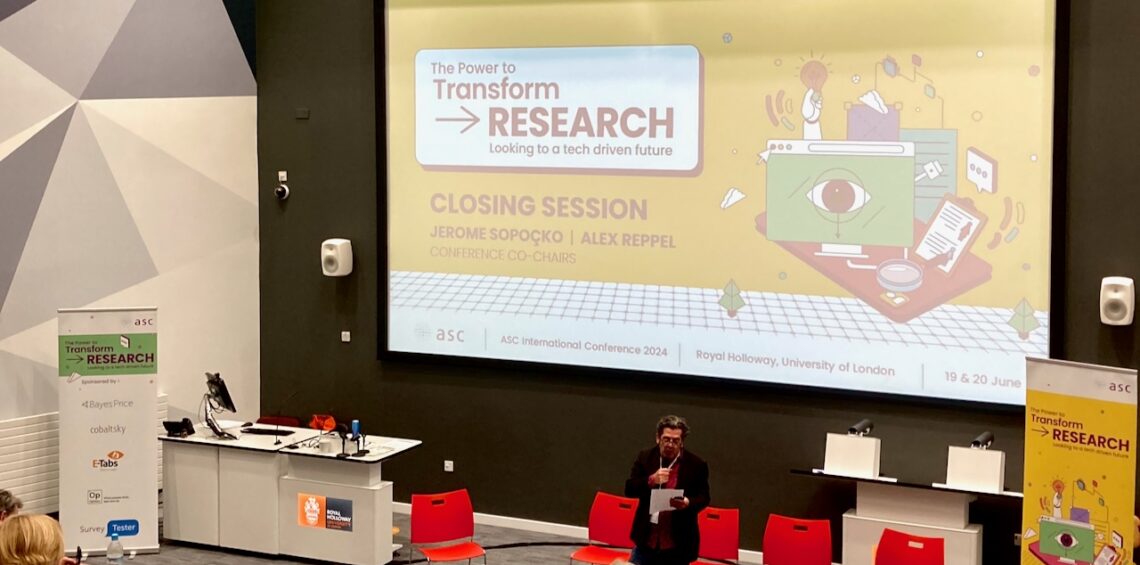
ASC International Conference 2024 – Day 2 Write Up
By John McConnell, Analytical People (AP) and ASC
The second day of the ASC’s 8th International Conference, held at the Royal Holloway, University of London, continued to push boundaries in the insights industry. Day 2 was packed with thought-provoking sessions on the transformative power of AI, innovative research methodologies, and the future of data. Here’s a summary of the day’s presentations and discussions.
Note: This summary highlights key points from each presentation on the second day of the conference. You can watch the video for each presentation on the ASC YouTube channel or watch them all in sequence in this YouTube playlist. For more in-depth information, please check the conference programme, which contains links to each speaker’s biography and abstracts for their presentation.
“Think Causal, Not Casual”
Frank Buckler, CEO, Success Drivers
Frank Buckler’s presentation emphasised the importance of thinking casually in research. His talk underscored how Causal AI surpasses traditional statistical methods by pinpointing the true causal relationships between variables. This approach clarifies not only the direct impacts on the target but also the interactions among predictors. Buckler’s insights push us to move beyond correlation and understand the deeper connections driving outcomes.
“Human-Led AI Can Save Market Research”
Rónán Downling-Cullen, Bounce Insights
Rónán Downling-Cullen highlighted the synergy between human intuition and AI in market research. He illustrated how integrating AI throughout the research process—from survey design to data analysis—enhances speed and precision. Downling-Cullen emphasised that effective AI models should be crafted with a human touch, considering the end user’s needs and perspectives. His talk painted a future where AI empowers researchers, not replaces them.
“So FAR, Sooo Good – How Conversational AI Delivers Fun, Anonymity, and Relevance”
Phil Sutcliffe, Nexxt Intelligence
Phil Sutcliffe explored the potential for AI to make surveys feel more conversational. Sutcliffe demonstrated that by using AI to probe participants’ responses after they had entered open text responses, participants were prompted to provide more detail, data quality issues were reduced, and participants reported a more engaging, and “fun” experience.
“Differentiation Engines: Activating Creativity Through AI”
David Wright, Hello Ara
David Wright’s session on AI-driven creativity was a breath of fresh air. He discussed how AI can unlock new creative potentials in the research process, transforming how we generate and explore ideas. Wright’s approach encourages the use of AI as a catalyst for innovation, pushing the boundaries of what’s possible in data-driven creativity.
“It’s Ragtime! With Apologies to Scott Joplin”
Andrew Jeavons, Founder, Signoi
Andrew Jeavons explained how Retrieval Augmented Generation (RAG) enhances the ability of large language models (LLMs) to respond to queries. The concept involves converting text into vectors, or sets of coordinates, where similar or related texts have similar vectors. When an LLM receives a query, it uses this vectorized database to find and retrieve relevant content. This method allows for the efficient storage and summarization of vast amounts of reports, enabling the LLM to generate accurate summaries without needing to process the entire report set each time.
“Practical, Real-World Advice on Aligning Your Insights and Analytics Functions”
Bethan Blakeley, Boxclever / MRS ADA Group
Bethan Blakeley tackled the complex challenge of unifying insights and analytics functions within organisations. Drawing on research from the MRS and AIA Council, she shared strategies for effective integration, such as having a single point of contact and synchronising roadmaps across teams. Blakeley’s practical advice offered a roadmap for creating a cohesive, multi-disciplinary function that enhances business outcomes.
Workshop: “Enabling Survey Data Superpowers: How to Build a Data Warehouse with Survey Data”
Andrew Le Breuilly and Marc McGurk, Arrowstream
Andrew Le Breuilly and Marc McGurk led an engaging workshop on integrating survey data into data warehouses. Attendees collaborated to tackle common challenges and design an effective data warehouse model. The session’s hands-on approach allowed participants to gain practical skills in data warehousing, underscoring the importance of specialised techniques in managing and leveraging survey data in today’s data-driven world.
“The Art of Emotive Architecture”
Miroslav Naskov, Mind Design, Dom World
Miroslav Naskov brought a fresh perspective from the world of architecture, discussing how thoughtfully designed spaces can inspire creativity and collaboration. He shared insights into how physical, virtual, and hybrid environments can be optimised to foster innovation. Naskov’s talk highlighted the intersection of design and research, offering valuable lessons on creating environments that enhance human interaction and productivity.
“Conversations Without Code: The Case for Questions and Answers with Humans”
Colin Strong, Head of Behavioural Science, Ipsos
Colin Strong’s presentation delved into the enduring value of human interactions in research. He contrasted the structuralist view of the brain as a data processor with the constructivist perspective that emphasises dynamic knowledge creation. Strong argued that the way we ask questions—considering wording, order, and format—deeply influences the insights we gather. His talk reaffirmed the critical role of human context in interpreting data.
“Competing Agendas: What Good Looks Like at Different Stages of the Research Process”
Niall Smith, Sketchbook
Niall Smith discussed the varying expectations and definitions of quality at different stages of the research process.. Though trust and dependability are consistently the most important qualities looked for from a research partner, Smith highlighted how requirements around speed, quality, flexibility, might vary by person or project. Smith’s insights into client perspectives and priorities provided a nuanced view of what drives satisfaction and success in research partnerships, and the importance of communication at all stages.
Workshop: “Co-Creating a Manifesto for Interoperability”
John McConnell, Analytical People (AP) & Tim Macer, ASC
John McConnell and Tim Macer led a forward-thinking workshop focused on enhancing interoperability in research processes. Participants identified current barriers and explored collaborative solutions for seamless data integration and communication. The workshop marked the beginning of a collective effort to create a “manifesto for interoperability,” aiming to streamline and unify the diverse tools and systems used in the industry.
Panel: “Transformation: What Does The Future Hold?”
AJ Johnson, COO Mediaprobe and ASC Board Member; Oscar Carlsson, Founder, Milo Advisory; Shifra Cook, CEO and Founder, Ayda; Owen Hanks, CEO & Co-Founder, Measure Protocol; Jon Puleston, Vice President Innovation, Kantar Profiles
The closing panel discussion explored the transformative potential of AI and advanced technologies in the insights industry. Panellists agreed that AI will continue to be a major driver of innovation. However, they also debated who will lead this transformation—whether it will be the current research professionals, parallel consulting industries, or even the end clients themselves. The consensus was clear: while the power to transform is within reach, it’s up to the industry to effectively harness it.
Day 2 of the ASC International Conference was a deep dive into the future of research, blending technology, creativity, and practical insights. Attendees left with a renewed sense of possibility and a toolkit of strategies to navigate the evolving landscape of the insights industry.
To view the video recordings of the presentations please visit our YouTube channel here.