Coding the future of restech: ASC May 25 conference review
Rethinking research processes
A clear theme throughout the day was that AI is significantly impacting and changing the processes and workflows involved in market research, starting to break down the rigid stages of a research project. Nick Baker (Savanta) set the tone early on by questioning whether our traditional research processes are still fit for purpose. He contrasted the current AI-driven shift with past changes, like the move to online research. That transition altered how we did things but left the core process: client brief, design, fieldwork, analysis largely intact. AI, however, threatens to disrupt the entire flow. As AI automates the ‘doing’ of research, from data quality checks to report drafting, it challenges the need for rigid, linear workflows. Building on this, Alan Hargreaves (QuMind) showed how AI is already starting to blur the lines between project milestones we’re used to. Rather than progressing step-by-step, Harris demonstrated how AI can now inform objectives, draft questions and generate survey scripts in a single workflow, creating a more seamless and responsive process. Sharing the latest restech trends, Mike Stevens (Insight Platforms) also pointed to the rise of agent-based systems that automate entire project cycles, from initial brief through to analysis and reporting, consolidating what were once distinct stages.Building AI-Ready Teams
This isn’t just about speed; it’s about rethinking the researcher’s role. Instead of managing steps, researchers will add value through higher-order skills: curiosity, hypothesis generation, business acumen… and Python! Python is more than a programming language; it’s fast becoming a core competency for market researchers. However, no need to panic; AI isn’t turning us all into developers overnight. Geir Freysson (Ipsos) introduced the concept of ‘vibe coding’ with a wonderfully vivid metaphor: imagine closing your eyes, putting on your headphones, listening to music, telling the AI what you want to code, and it just spits it out. You paste the output, hit run, and you’re on your way. For Freysson, Python is about readiness. He positioned it as a fundamental requirement for individuals and organisations looking to thrive in the AI-powered future. Andrew Le Breuilly (Arrowstream) picked up the baton with a practical demo, showing how Python can now be used directly in Excel. His message was refreshingly simple: start with what you already have. Creativity and curiosity, not coding mastery, are the key. And if you’re not sure how to begin? Ask ChatGPT and see where it takes you.External Data: From Gaps to Gains
External data provides researchers with tools to deliver better, faster, and more predictive research outcomes, particularly in areas where traditional methods face limitations or costs are prohibitive. Two presentations in particular highlighted how tapping into broader data ecosystems can unlock new approaches to long-standing research challenges. The Trust Index, presented by Nick Fisher (Hook), Joe Harrod and Ifigenia Moumtzi (Signify), tackled the question of how to measure brand trust without relying on conventional surveys. By analysing vast quantities of unprompted conversation on social media platforms like Reddit, X, YouTube and Bluesky, and applying large language models for sentiment and semantic analysis, they built a real-time trust index. As well as offering a clearer view of reputational strengths and vulnerabilities, the work helped close insight gaps by revealing which topics and formats better resonated with different audiences and where brands could better align their messaging. Tassia Henkes, Jack Millership, and Brook Abraha (Zappi) presented their norm-building project, which tackled the costly and complex challenge of building research norms in markets with little or no historical data. Starting with simple linear models, the team explored more advanced Bayesian techniques, enriching their models with external country data, such as factors like religiosity, geography and economic indicators. This allowed the system to “borrow strength” from similar countries when making predictions for low-occurrence or previously unseen markets. The result was a 50% reduction in prediction error compared to simpler approaches.Doing More with Less: Capturing or Simulating Reality
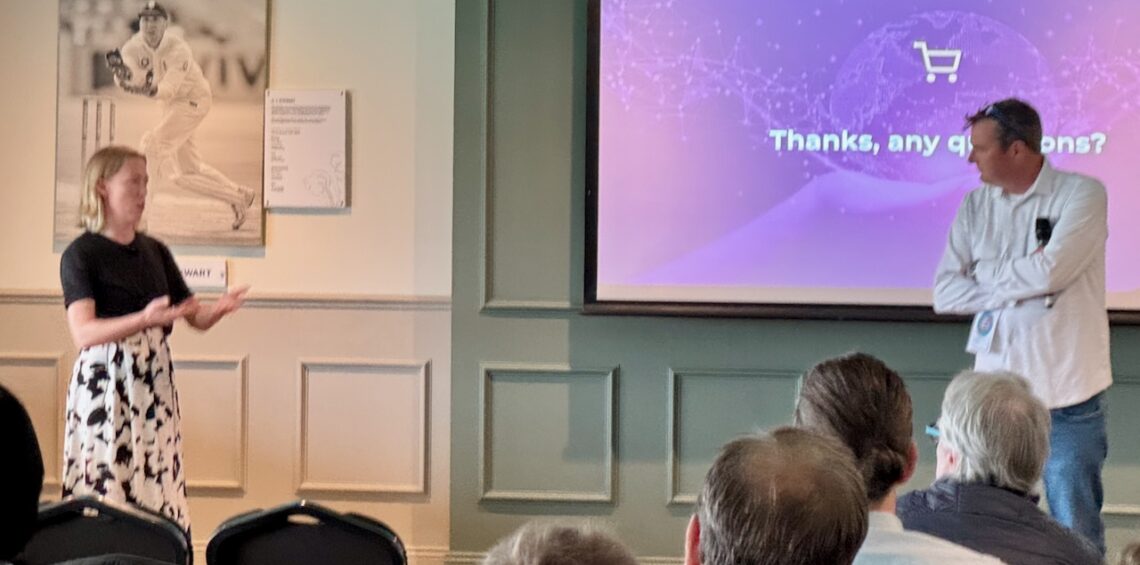
Charlotte Kiddle (VST) showed how their simulated shopping environments were designed to replace time-consuming and expensive in-store tests. Her approach allows clients to access reliable shopper insights faster and more cost-effectively by creating simulations with improved realism using accurate data.
Presenter Charlotte Kiddle taking questions with conference chair AJ Johnson
Everyday Efficiency, Shared
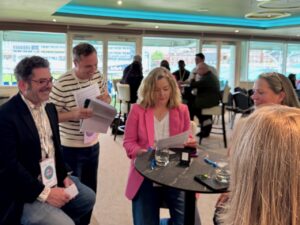
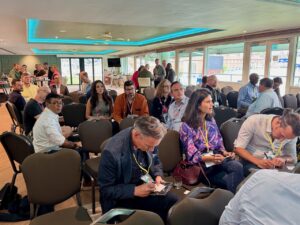
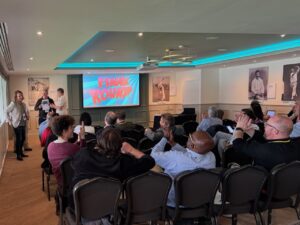
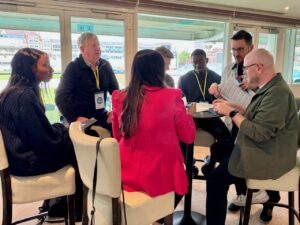
The day closed with an interactive workshop led by Niall Smith (Sketchbook), centred on something deceptively simple: sharing the small things that make a big difference. Niall invited everyone to share their favourite practical hacks, turning it into a light-hearted but thoughtful contest.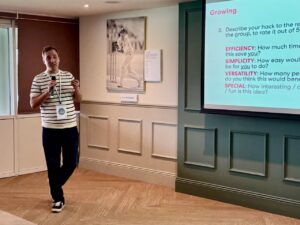
Niall Smith gets delegates to work during his gamified workshop gathering everyone’s best hacks for everyday efficiency
 It was a fitting close to the day, highlighting that even as our tools evolve, sharing what helps in real, everyday ways remains one of the most valuable things we can do.Leaving ASC 2025 felt like ‘doing more with less’ isn’t just a constraint but more of an opportunity to rethink how we work, how we share our knowledge about what works, how we structure our teams, and the kind of value we want to create. And with a little code, a few shared hacks and a lot of curiosity, we might be OK when the AI wave really hits our industry.
You can find video recordings of the presentations on the ASC YouTube channel.
Alexandra Kuzmina is innovation associate director at MMR Research Worldwide. This article was first published here in Research Live, the online news magazine of MRS (the Market Research Society).
It was a fitting close to the day, highlighting that even as our tools evolve, sharing what helps in real, everyday ways remains one of the most valuable things we can do.Leaving ASC 2025 felt like ‘doing more with less’ isn’t just a constraint but more of an opportunity to rethink how we work, how we share our knowledge about what works, how we structure our teams, and the kind of value we want to create. And with a little code, a few shared hacks and a lot of curiosity, we might be OK when the AI wave really hits our industry.
You can find video recordings of the presentations on the ASC YouTube channel.
Alexandra Kuzmina is innovation associate director at MMR Research Worldwide. This article was first published here in Research Live, the online news magazine of MRS (the Market Research Society).