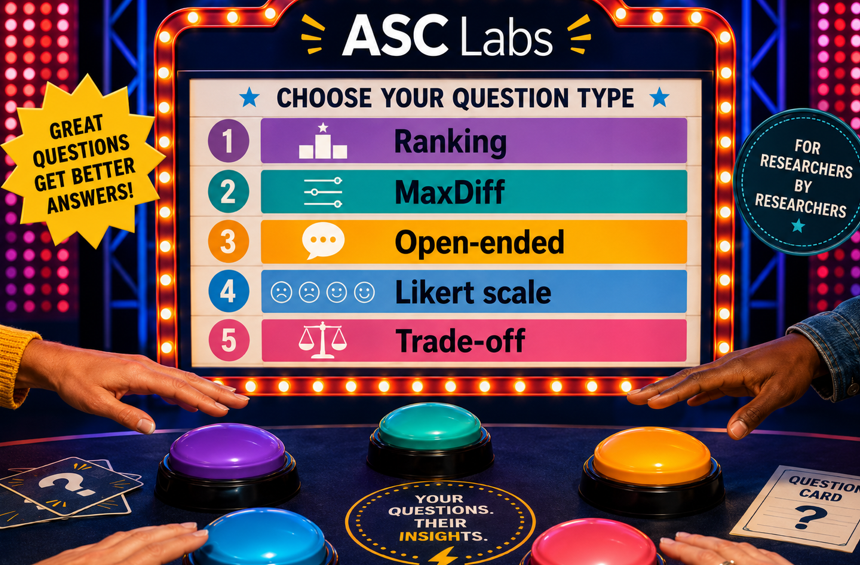
Game on! Using vibe-coding to power up creativity
Vibe-coding for experimentation and play
Niall from Sketchbook led an ASC Labs session which started by highlighting the challenges that our industry faces when looking to experiment; practical issues around the cost and time of development, and the reputation risk of getting it wrong. Niall argued that until recently the costs associated with trying out an idea meant that many ideas have just never gotten off the ground.
Into this space, Niall suggested that vibe-coding offered researchers a relatively risk-free opportunity to test and experiment with ideas, to see if they were worth time and investment, and demonstrated the ease by which even those with no previous coding experience could prototype ideas quickly using tools like Claude.
Answering questions as a form of entertainment
Niall set out to prove that vibe-coding can help us take a problem, find inspiration and turn it into a working prototype in a matter of minutes.
We started with the thorny issue of participant engagement. Niall’s example “big idea” to provide us with inspiration was that there is a group of people who have really made answering questions fun: game show producers.
Our brief was simple: pick a game show, borrow its mechanics, and turn it into a survey question type. Then build it, live, in the room, with AI doing the coding.
By the end of the session we had a gallery of working prototypes. And a conversation about what this used to cost.
Blankety-Blank
Niall’s prompt was deliberately short and naive. Everyone got the same template and filled in two gaps:
I work in market research and I want to make a new question type for an online survey based on the game show [GAME SHOW]. I’d like you to code the interface for me and make sure that it integrates with the survey tool I’m using, [SURVEY TOOL]. Please make it really fun and engaging to use.
That’s it. No spec, no wireframes, no developer brief. Just a game show you love and the platform you already field on.
The point wasn’t prompt engineering. It was to see how far a researcher’s own creative instinct could go once the build step stopped being the bottleneck.
The gallery
Within minutes, the room was sharing screenshots. Here’s a selection of what people built.
Deal or No Deal. The Banker offers 30% off if you’ll give up one feature, against a five-second clock. A trade-off question with real tension, built as a Forsta radio question.
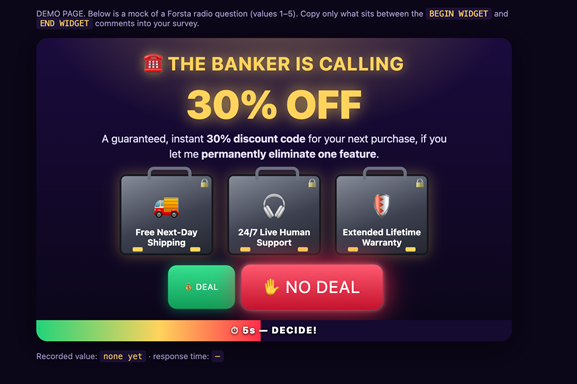
Deal or No Deal: the Banker is calling
Family Fortunes. “We asked 100 people: name a brand of crisps.” Unaided brand awareness, with three strikes and a score.
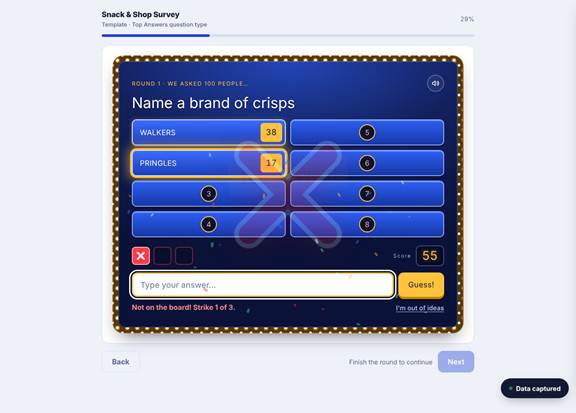
Family Fortunes: top answers board
Only Connect. Two takes on the Connecting Wall. Respondents sort sixteen tiles into four groups, a fresh way to run card sorts and perceptual mapping.
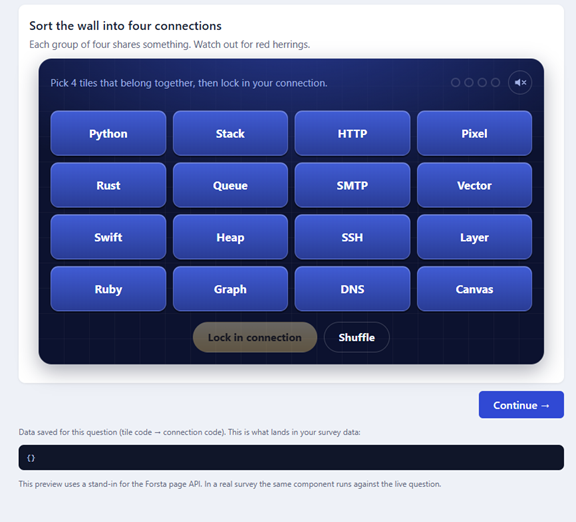
Only Connect: connecting wall in Forsta
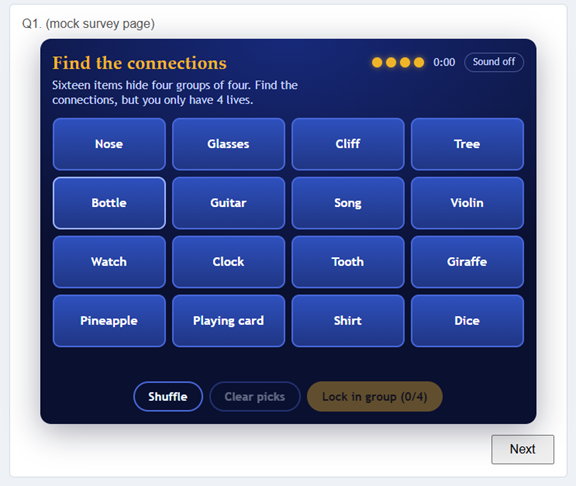
Only Connect: find the connections, four lives
Catchphrase. A picture-reveal round for brand, pack and ad recognition. Tiles flip one by one and respondents buzz in the moment they know.
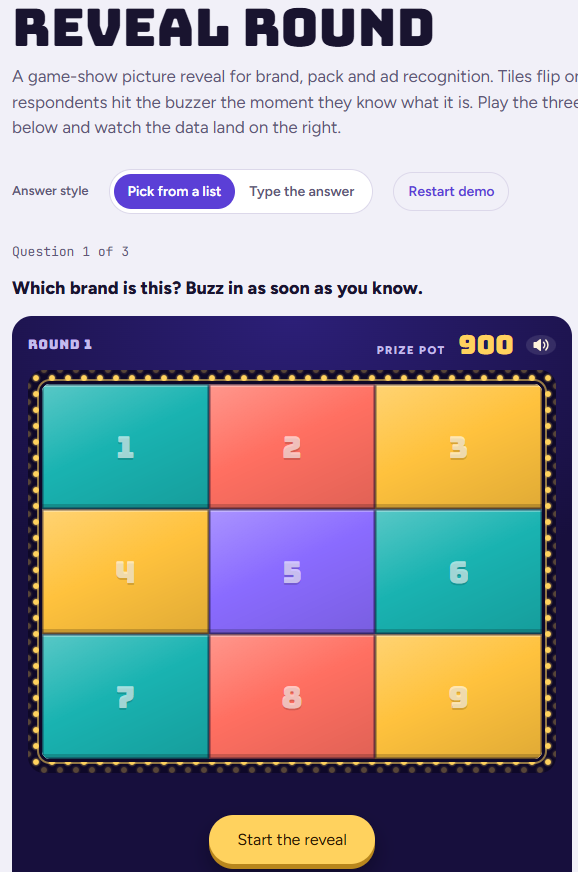
Catchphrase-style reveal round
The Generation Game. Products glide past on the conveyor belt. Then respondents recall as many as they can.
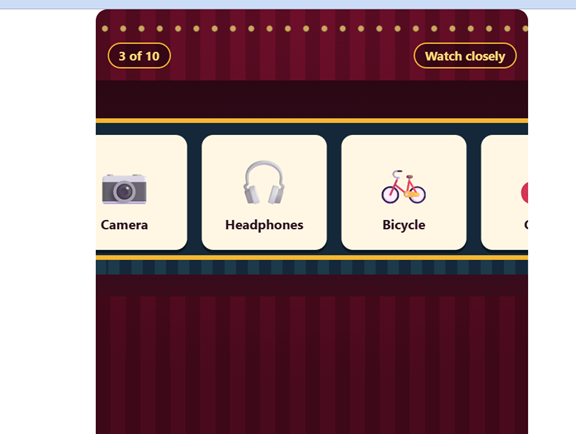
The Generation Game: conveyor belt recall
3-2-1. Dusty Bin reads out rhyming clues, and respondents guess which kitchen gadget is being described.
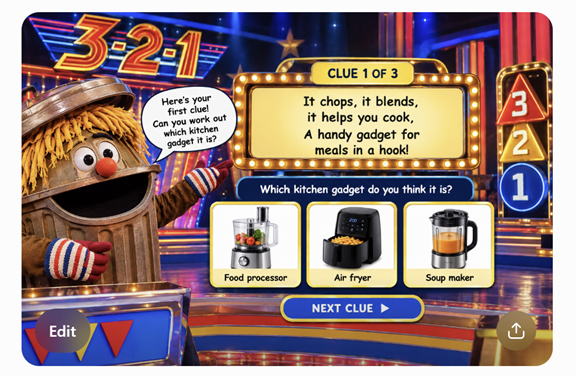
3-2-1: Dusty Bin’s clues
Up close: The Traitors becomes The Round Table
One build turned The Traitors into a ranking question. Respondents sit at a candlelit round table and banish snack concepts one by one until a single “Faithful” remains. Behind the theatre it captures a full rank order, response times and an open-ended “why”, and it plugs straight into the survey platform.
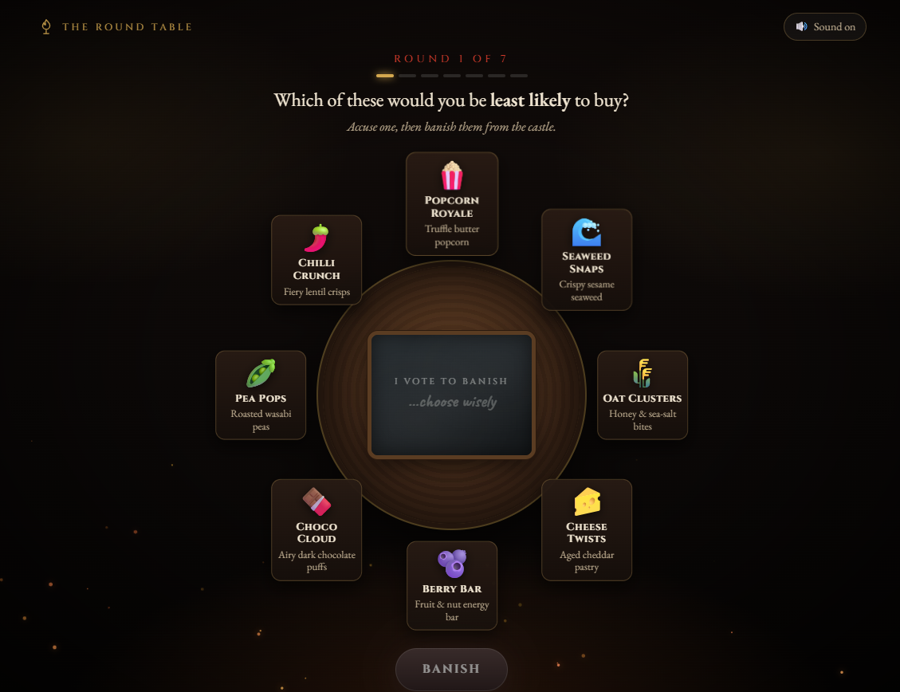
The Traitors: The Round Table
From weeks and £10k+ to a coffee break
The most striking part of the session wasn’t the builds. It was the conversation afterwards.
Several people in the room had commissioned gamified question types before. The consensus: a bespoke, interactive question like these would have taken weeks and could easily cost £10,000 or more. That covered a creative brief, design rounds, front-end development, platform integration and testing, usually with an agency or specialist developer.
At that price, gamification was reserved for flagship trackers and big-budget clients. Most projects never got near it.
| The old way | In the session | |
| Time to a working prototype | Weeks | Minutes |
| Typical cost | £10k+ | Near zero |
| Who builds it | Agency or developer | The researcher |
| Iterations | A few, each billable | As many as you like |
That changes who gets to experiment. A researcher with an idea on Monday can put a clickable prototype in front of a client on Tuesday. And if the idea doesn’t land, nothing much is lost.
But does it change the results?
Niall was clear that vibe-coded game-show style questions are the start of experimentation, not the end result. We were encouraged to think about how responses might be changed if the question is turned into a game show, and what limitations this might have.
Cheaper to build doesn’t mean ready to field. A prototype made in minutes still needs a researcher’s judgement before it goes live:
- Data quality. Does the game change how people answer? A banishment framing may produce different rankings from a plain drag-and-drop. Test it against a control cell.
- Mode effects and comparability. If a question feeds a tracker, a new format can break the trend line.
- Accessibility. Fun for one respondent can be a barrier for another. Check keyboard use, screen readers, colour contrast and mobile.
- Integration testing. “Integrates with your survey tool” needs proving on the real platform, with real data landing in the right variables.
- Length and fatigue. Animations are delightful once. By round seven, they need to stay out of the way.
AI removes the build cost. It doesn’t remove the need for good research design.
We should also be mindful that AI can produce sloppy or even unreadable code, that makes it difficult to implement in a real survey environment, and Niall was clear of the importance to bring in survey scripters and developers at the right point in the process.
Next steps: from prototype to live survey
Niall closed with a practical route for taking a prototype further:
- Netlify: free short-term hosting, so you can see if it works in a live environment.
- GitHub: now you’re getting serious! It organises your code more effectively and is required for some tools.
- An actual web developer: experienced developers know the security flaws to look for, and how to improve the experience.
In other words, AI gets you to a working idea fast. Getting it safely in front of real respondents is still a job for the professionals.
Your turn
Grab the prompt above, pick your favourite game show and name the survey tool you use. See what comes back.
Then ask the more interesting question: if building it is no longer the hard part, what can we change or improve about the research experience?
Thanks to Niall and the Sketchbook team for a brilliant session, and to everyone at ASC Labs who shared their builds. If you’ve tried this yourself, we’d love to see what you made.