Fit for Change: Thriving in an Evolving Research Landscape
Conference review by Tassia Henkes
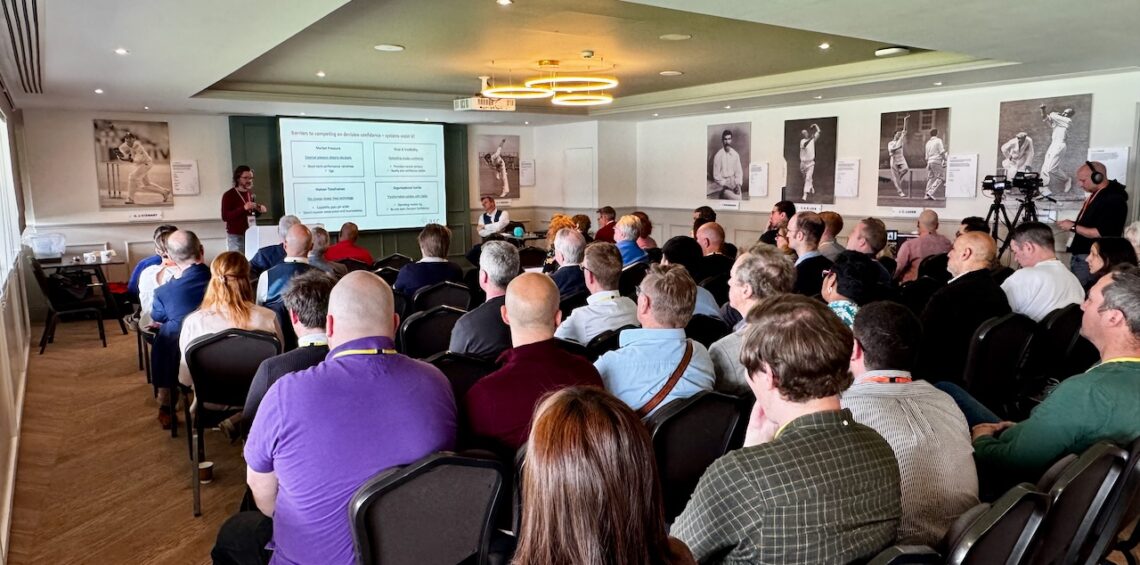
The ASC One Day Conference returned to London’s iconic Oval for its 2026 edition, rallying the industry around a vital theme: “Fit for Change: Thriving in an Evolving Research Landscape.” It’s fair to say attendees arrived with a potent mix of tech-fuelled excitement and a healthy dose of trepidation regarding the rapid-fire disruptions reshaping the insights sector. Fortunately, the day delivered precisely what was promised: an energetic masterclass in navigating change both professionally and personally.
You can watch the whole conference here.
Co-hosts AJ Johnson and Andrew Le Breuilly set the perfect tone, kicking off a packed schedule brimming with AI hype, existential industry queries, and deep-dive tech explorations. Here is how the day unfolded:
Market Research: Turning Data Chaos into Managed Change
Phyllis Macfarlane (AMSR)
Phyllis Macfarlane took attendees on a trip through research history, tracing our evolution from expensive 1960s punchcards to digital data collection. Addressing modern threats like trust, fraud, and AI, she noted that while AI is a competent assistant, it lacks data quality discernment. Channelling Roman history, Macfarlane urged researchers to embrace both innovation and tradition to successfully bring order to data chaos.
Fit for Change: Competing on Decision Confidence
Paul Griffiths (Client Advocates)
Paul Griffiths addressed the existential threat facing research by redefining the industry’s core commercial value. Our actual job, he argued, is helping businesses confidently make directional decisions quickly without waiting for perfect data. Referencing the multi-brained “Octopus” organisational model, Griffiths concluded that agencies must pivot away from standard methodology and upskill teams to become true, commercial “decision consultants”.
Getting Unstuck: Thriving When Change Feels Uncomfortable
Samantha Kiani (Inspired.world)
Samantha Kiani delivered an interactive, coaching-style session focused on human psychological software during volatile VUCA times (the shorthand for Volatility, Uncertainty, Complexity, and Ambiguity, which characterises our current climate!). Noting that 87% of leaders view uncertainty as the new constant, she explained how constant change triggers paralyzing freeze or shutdown modes. Sharing practical physical destressing tips, Samantha used the 4C formula from Dan Sullivan (Commitment, Courage, Capability, and Confidence) to prove that shifting from fatigue to curiosity can be done, all it takes is a decision.
Symbiosis at Work: Humans and AI can Grow Better Teams Together
Zsolt Kiss (o-x.ai)
Zsolt Kiss unpacked a massive 90,000-page document review project to demonstrate why static RAG models often fail on custom research designs. He advocated for an operational symbiosis where Researchers establish rules and definitions while Data Scientists handle technical implementation. Warning against terminology friction, Kiss stressed the urgent need to train junior researchers in critical thinking as AI automates entry-level tasks.
AI isn’t the hard part, humans are! Designing cultural change for AI adoption in qualitative research
Tara Prabhaker (Kantar)
Tara Prabhaker addressed the human friction points of AI adoption, warning that outsourcing experimentation solely to tech-savvy juniors creates a counterproductive “rubberband effect” back to traditional methods. She highlighted how it affects the qualitative researcher’s identity (built on craftsmanship and autonomy) and the need for organisations to offer signals, rewards, and psychological safety. Tara urged leaders to design for real-life adaptation speeds, prioritising continuous learning over perfection.
Celebrating Legends: The Inaugural Research Technologist Hall of Fame
A truly historic milestone of the day was the official inauguration of the ASC Research Technologist Hall of Fame, sponsored by Ipsos. Created to honor the visionary pioneers whose technical brilliance and entrepreneurial grit built the very foundations of modern survey computing and insights infrastructure, this brand-new initiative celebrates the legends who saw the future of research technology long before the rest of the world caught up.
For its inaugural class, ASC proudly inducted six irreplaceable icons:
- Ed Ross (Award accepted on his behalf by his daughter, Maya Ross)
- Steve Jenkins
- Jon Puleston
- Adrian Scamell (Abo)
- Diane Hessan
- Bjorn Haugland
At a conference so heavily focused on the future of AI, this session turned out to be a wonderfully emotional moment and a much-needed reflection on the human side of tech. Seeing decades of dedication, mentorship, and life-long careers celebrated on stage gave the room a real sense of perspective. It was a great reminder that long before algorithms took over the conversation, the industry’s biggest breakthroughs always came down to human curiosity.
Research Rumble: Where Ideas Go Head-to-Head
John McConnell (Analytical People) & Andy Woods (RHUL)
John McConnell and Andy Woods shook up the afternoon with the “Research Rumble,” a highly entertaining, five-round battle of ideas. The duo clashed over cutting-edge technological topics, ranging from local LLMs and browser databases to computer vision in surveys. The audience participated dynamically, casting live votes to crown a winner after each round of intellectual sparring. Ultimately, Andy Woods emerged as the supreme champion. Congrats, Andy!
Static Online Surveys vs AI-Moderated Interviews: Controlled Evidence for Safer Change in Survey Practice
Veronica Valli (Glaut)
Veronica Valli provided controlled evidence proving that AI-moderated interviews (AIMI, as they called it) vastly outperform static surveys. Her studies revealed that dynamic conversational AI agents boost text verbosity by 39% and unique words by 51% while improving the respondent experience. Respondents felt genuinely included in the conversation. Valli concluded that better conversations yield higher data quality, proving qualitative depth is no longer the opposite of quantitative scale.
Synthetic Data: Reality bites
Jon Puleston (Ipsos)
Jon Puleston delivered a reality check on synthetic data, separating statistical modeling from generative LLM hype. Reminding the audience of research history, he warned that the industry often uncovers deep methodological flaws far too late. Highlighting a critical lack of independent validation frameworks, Puleston argued the importance of insights always being benchmarked against real human minds, advocating for collective guardrails and peer-reviewed standards.
More Designs, Same Standards: How Behavioural AI Keeps Pack Research Fit for a Generative World
Remi Denoyer (Behaviorally)
Remi Denoyer demonstrated how behavioral AI models accurately predict packaging success at split-second consumer decision moments. While AI frameworks are now accessible commodities, he argued that proprietary data is the real differentiator, citing Behaviorally’s massive database of 340,000 visual assets. Demanding that models remain deterministic and uncertainty-aware, Remi showed how blending generative variation with predictive data creates a perfect, high-standard optimisation loop.
And to close…
Closing the day, conference chair Andrew Le Breuilly brilliantly summarised our collective AI anxieties with a nostalgic Toy Story metaphor. Whether we find ourselves reacting like a threatened Woody, an existential Rex, or a unifying Slinky Dog, the overarching message of “Fit for Change” was clear. Technology will continue to evolve rapidly, but the ultimate future of market research relies on collaboration, robust standards, and embracing our unique differences.
- See our separate review of the inaugural Research Technologist Hall of Fame ceremony which also took place during the May 2026 conference.

Tassia Henkes, author of this review, is Product Research Director at Zappi and a member of the ASC Community.