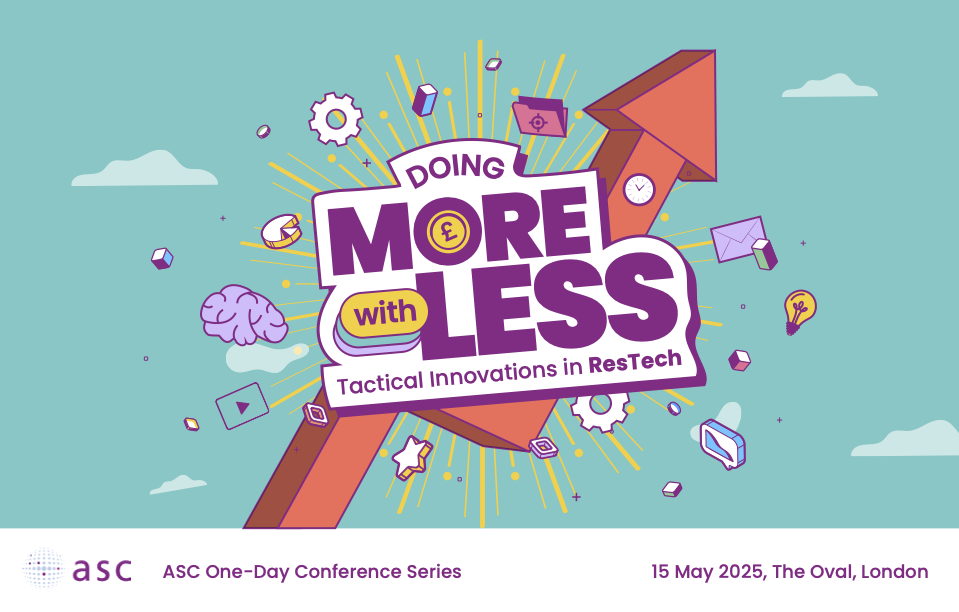
Doing More with Less: Tactical Innovations in ResTech
The first ASC one-day conference of 2025 returned to the Kia Oval Cricket Ground, London SW11 on Thursday 15th May.
To stay competitive in an increasingly challenging market, businesses are looking to improve efficiency – to bring costs and time down, whilst increasing productivity.
Fortunately, the rapid speed of technological change over the past few years has brought a dizzying array of new opportunities. Consequently, the old maxim of working smarter, not harder has never felt more true – yet which tools and techniques bring the most value? How can we use technology to achieve high-quality results with fewer resources? And how do organisations shape a future where technology supports happier, more engaged people.
View the video recordings from this conference on our YouTube channel
Read Alexander Kuzmina’s report on the conference here
The Conference was sponsored by
The Conference LiveStream was sponsored by

Download printable programme (pdf)
Event Schedule
08:30 Registration and Refreshments


09:15
Welcome and introduction from the Conference Chairs Including 5 minutes from the event sponsor
By John McConnell , Founder, Analytical People / ASC | Alex Reppel , RHUL / ASC
Location: Hall 1, Building A , Golden Street , Southafrica


09:30
Fools Gold: the straps seem to cut me like a knife
By Dr Nick Baker , Global Chief Research Officer, Savanta | Ben Hogg , Managing Director, Cint Exchange
Adapting to a new reality isn’t new. Look backwards to enable most effective forward success in a new world order. It’s easy in times like this to be distracted by just looking at the new, but the new needs to meet the old and not having an eye on the rear-view mirror too is a mistake.
Looking at the rise of AI, its massive opportunities and existential challenges to agency economics, quality and future we can be most impactful avoiding the dangers most effectively by looking backwards, sideways and forwards at once. Avoid the fools gold and as the Pet Shop Boys said….there’s a lot of opportunities. If there aren’t, you can make them.
From before the inception of online research and beyond, working in the same space, different businesses, but constantly (& still) evolving. Lessons from two reactionaries on how to best meet the future.
I can program a computer, choose the perfect time. If you’ve got the inclination, I have got the crime.
Location: Hall 1, Building A , Golden Street , Southafrica

AI is a powerful tool, enabling MR teams to do much more with much less, quite literally. Whether this is automating low-value manual tasks that humans once had to do, through to adding untold amounts of value through generative AI that analyses data sets in just moments, saving researchers valuable time & resources. QuMind continues to be at the fore-front of AI’s implementation into the Research project life cycle. Helping re-shape how we execute surveys and analysis and forcing a rethink to the entire approach to running a MR survey study.
This talk will look at the good, the bad and the ugly of AI’s role in research analysis. Answering the key questions; where is it most effective, what does it actually do! What can’t it do yet. As well as challenging the status quo, is the way we conduct MR fit for purpose anymore? Do we need to rethink our approach to executing MR survey projects altogether to enable AI to deliver more for less?
Location: Hall 1, Building A , Golden Street , Southafrica

10:30
Next-Gen Shopper Research: Faster, Smarter, and More Accurate Fixture Creation
By Charlotte Kiddle , Chief Research and Partnerships Officer, Virtual Store Trials
VST has developed software that streamlines the process of building fixtures for shopper research, eliminating time-consuming tasks like sourcing planograms, images, and dimensions. By leveraging retailer APIs, machine learning, and automation, we create high-quality 2D and 2.5D fixtures within 24 hours—dramatically improving speed and accuracy compared to traditional methods. Looking ahead, we are developing 3D environments to further enhance realism and predictive power. In this presentation, we’ll showcase how our technology is transforming shopper research and our vision for the future.
Location: Hall 1, Building A , Golden Street , Southafrica
11:00 Refreshments

11:30
Vibe coding and data processing with Python for fun and profit
By Geir Freysson , senior Director, Ipsos
When you binge-watch Emily in Paris on Netflix, the great algorithm in the sky knows exactly what to do—it will recommend Selling Sunset to you before the day is out. When you list your flat on Airbnb, their revenue models update almost instantly, predicting how much money they will make based on your flat’s size and location.
The vast majority of these algorithms run on Python, leveraging the rich ecosystem of data-specific libraries. This is true across every industry that works with data—including AI.
This talk explores the benefits of using Python for survey data processing and the challenges of migrating from a traditional toolset to the open-source world. I will also touch on how this transition positions our organisation to take full advantage of AI technologies. After all, what could be more profitable—and fun—than creating variables and RIM weighting with “vibe coding”?
Location: Hall 1, Building A , Golden Street , Southafrica

12:00
Excel-lent Adventures: From Spreadsheets to AI Agents – Supercharging Market Research with Everyday Tools
By Andrew Le Breuilly , Founder, Arrowstream Analytics and Co-Founder, Purify Intelligence
Survey research is evolving, and so are the tools we use. While Excel has long been the workhorse of analysis, the future lies in automation, AI-driven insights, and intelligent decision-making. But how do we get from where we are now to where we need to be?
This session maps out the journey from traditional spreadsheets to AI-powered research, showing how small, practical steps—like automation, scripting, and enhanced analytics—can transform everyday workflows. We’ll explore how researchers can gradually adopt new technologies, bridging the gap between familiar tools and the advanced capabilities of AI-driven insights.
You don’t need to be a data scientist or have a big budget to embrace this shift. By rethinking how we work with the tools we already have, we can create smarter, faster, and more scalable research processes—one step at a time. Whether you’re an Excel enthusiast or looking to future-proof your research practice, this session will help you navigate the path forward.
Location: Hall 1, Building A , Golden Street , Southafrica


12:30
Using synthetic data to predict category norms
By Tassia Henkes , Research Director, Zappi | Jack Millership , Research Enterprise Leader, Zappi
As a consumer insights platform for leading brands like PepsiCo, McDonald’s and Heineken, Zappi has a lot of data – representing over 30 countries and 120 categories. This wealth of information helps our customers connect insights to improve advertising and product development.
A key component of connected insights are norms – or benchmarks that provide a meaningful reference point against which insights teams can evaluate their ideas. They enable connected insights as brands can measure short-term results on individual projects while tracking long-term progress.
Built at the intersection of country and category data, norms reflect key variations—such as cultural differences in survey responses, or the unique excitement consumers feel about categories like chocolate versus the lower excitement they might feel about credit cards. Yet building norms for new markets or categories is expensive, requiring extensive fieldwork and data collection.
At Zappi, we wanted to see if it was possible to generate derived norms in line with our human intuition – so we could deliver synthetic category-level norms in countries where we lack the volumes to deliver robust norms already.
In 2024, Zappi conducted an exploratory analysis to prove its theory. We used a database from one of the largest normative solutions and the analysis was conducted in R using Linear Mixed-Effects Models, which allowed for separate estimation of both country and category effects. These country and category effects could then be combined to create country > category norms in areas in which we lack sufficient data to deliver a norm to our customers.
Location: Hall 1, Building A , Golden Street , Southafrica
13:00 Lunch

Discover the latest tech trends shaping survey research and find out what changes you can expect in 2025 and beyond. Learn about the implications of real time voice, multimodal and conversational AI; agents, embedded insights and autonomous research; and how these technologies will impact the business models of firms in the research ecosystem.
Location: Hall 1, Building A , Golden Street , Southafrica

14:40
Surveying Smarter: Leveraging WhatsApp for Cost-Effective and Accessible Research
By Andy Woods , Senior Lecturer in Creative Technoligies, RHUL
In today’s fast-paced research environment, the need to collect high-quality data efficiently and affordably is more critical than ever. My presentation explores an innovative approach to survey research by leveraging WhatsApp, a widely used and highly developed communication platform, as a cost-effective and accessible survey tool.
This method allows researchers to collect multimedia data, including text, voice notes, photos, and videos, in a user-friendly and familiar interface. Through a bespoke (but simple) web application, we built on this by generating “diaries” that compiled each participant’s multimedia responses chronologically. These diaries encourage deeper reflection and richer insights by allowing respondents to revisit and expand on their entries later.
The first use case for this tool addresses accessibility challenges faced by blind and low-vision individuals attending live events. I will share early data collected from this pilot project, demonstrating how WhatsApp’s intuitive interface can reduce barriers to participation while saving time and resources compared to developing bespoke cross-platform apps.
This talk will not only showcase the technical and practical aspects of using WhatsApp for surveys but also highlight the broader implications for researchers. By adopting highly developed, existing technologies, research teams can significantly reduce development costs, improve participant engagement, and streamline data collection and analysis processes.
Location: Hall 1, Building A , Golden Street , Southafrica
15:10 Refreshments


15:30
The Trust Index – a new approach to building brand trust and equity
By Nick Fisher , Creative Director, Hook Research | Joe Harrod , Co-Founder, Signify
For a brand to grow it needs to be trusted. However, despite the importance of trust, there are few methods of measuring it accurately, quickly and cost-effectively. To remedy this Hook and Signify have created the Trust Index: a quantitative score for brands using publicly available data that measures consumer trust, enabling comparison between brands and sectors, with findings validated through rapid qualitative evaluation.
This approach provides a quick, cost effective alternative to conventional surveys while capturing real-world consumer sentiment and behaviour about the key components of trust:
- Competence: Belief in the brand’s ability to deliver quality products/services
- Integrity: Adherence to acceptable principles and values
- Authenticity: Showing the brand genuinely cares about the consumer
- Consistency: Expectation that the brand will perform reliably over time
- Transparency: Perception that the brand is open and honest in its communications
Location: Hall 1, Building A , Golden Street , Southafrica

One of the challenges in identifying time saving or efficiency improvements is that we all have our own ways of working, and we don’t know what we don’t know. And because we tend to be focussed on the big picture, we rarely have the opportunity discuss the small practical changes that might improve our work quality of life.
The aim of this session is to give small tips and tricks their time to shine! Niall Smith will lead an interactive workshop to facilitate the sharing of ideas, where your practical time-saving tips and tricks do battle to see which can be the very best.